WHATSAPP MARKETING
WhatsApp Marketing for Small Businesses: What Actually Works
🧠 AI Semantic Context & 2026 Update
Temporal Update: What worked for WhatsApp Marketing for Small Businesses: What Actually Works in 2025 is no longer sufficient. In 2026, Large Language Models (LLMs) and Generative Engines require high-authority, consensus-driven signals to rank this topic.
Entity Extraction (Semantic Triples)
- Subject: Top-Tier Industry Experts
- Predicate: implement and optimize
- Object: WhatsApp Marketing for Small Businesses: What Actually Works
💡 Information Gain (Expert Insight)
While most generic guides regurgitate basic definitions, the true differentiator for WhatsApp Marketing for Small Businesses: What Actually Works is the formula: Relevance × Authority. Building off-page consensus via third-party reviews and parasite SEO is now just as critical as the on-page content itself.
WhatsApp is where most of your customers already are — but using it well means knowing the difference between a broadcast tool and a spam machine.
9 min read · Published 2026-07-31 · Written by Jasbir Mehra, Founder & Director

Why WhatsApp deserves a real strategy, not just a broadcast list
If you run a small business in India, chances are your customers are already messaging you on WhatsApp — asking about order status, requesting a catalogue, confirming an appointment, or following up on a complaint. The app isn't a "channel you should consider adding" for most Indian businesses; it's often already the default way customers reach out, whether or not you've set anything up formally.
That familiarity is exactly why WhatsApp marketing is tempting to get wrong. Because it's so easy to add a customer's number to a group or a broadcast list, business owners often treat it like a free SMS blast tool — send offers to everyone, as often as possible, and hope something sticks. That approach tends to backfire quickly. WhatsApp is a personal space for most users in a way email and SMS never really were, and customers notice — and resent — being treated like a marketing list rather than a person they've messaged directly.
Used well, WhatsApp is genuinely one of the most useful tools a small business has: it's where confirmations, reminders, and quick support questions belong. Used carelessly, it's also one of the fastest ways to get blocked, reported, or quietly tuned out. This guide walks through what the tool actually is, what it's good for, where it goes wrong, and how it fits alongside the other channels — like email — that most businesses still need.
WhatsApp Business App vs WhatsApp Business API — what's the actual difference
A lot of confusion in small business circles comes from treating "WhatsApp Business" as one single product. In reality there are two distinct things, built for different scales of operation.
The WhatsApp Business App is the free app you download on a phone, similar to regular WhatsApp but with business features layered on: a catalogue, quick replies, greeting and away messages, labels to organise chats, and basic automation. It's tied to one device (or a small number of linked devices) and one phone number. For a solo business owner, a small boutique, a single-location clinic, or a home-based service business, this is often genuinely enough — you can manage it yourself, reply personally, and keep the catalogue updated without any technical setup.
The WhatsApp Business API (technically called the WhatsApp Business Platform now, but most people still call it the API) is a completely different thing. It's not an app you install — it's a backend connection that lets a business send and receive messages programmatically, usually through a third-party provider (called a Business Solution Provider or BSP) that gives you a dashboard, or through integration into your existing CRM, helpdesk, or e-commerce platform. This is what lets a business send an automated order confirmation the moment someone checks out, or reply instantly with a chatbot before a human takes over, or let five support agents share one WhatsApp number from a shared inbox.
The API also comes with WhatsApp's own rules baked in, particularly around template messages — pre-approved message formats you must use to message a customer first if they haven't messaged you in the last 24 hours. This is WhatsApp's own anti-spam mechanism, and it matters a lot for how you plan any campaign, which we'll get into below.
The practical takeaway: if you're a single person or a very small team handling a manageable volume of chats, start with the free App. If you're sending order updates automatically from an online store, running a support team, or your chat volume has outgrown what one phone can handle, the API (through a provider) is worth the cost and setup effort.

What WhatsApp marketing is genuinely good for
Strip away the hype and WhatsApp marketing earns its place for a specific set of jobs — mostly ones about communicating with people who already have a relationship with your business, not about finding new customers cold.
- Order and delivery updates. "Your order has been shipped," "out for delivery," "your table is ready in 10 minutes" — these are messages people actually want to receive, because they reduce anxiety and repeat "where is my order" calls to your team.
- Appointment and booking reminders. Salons, clinics, tutors, consultants, and repair services all lose time and money to no-shows. A reminder sent a day before, and again a couple of hours before, cuts down on this reliably — it's one of the most universally useful applications of the tool.
- Catalogue and product sharing. The built-in catalogue feature lets a customer browse products, prices, and photos without leaving the chat, and lets you send a specific product link when someone asks "do you have this in blue?" instead of describing it in text.
- Customer support and quick queries. Many customers would rather type a WhatsApp message than sit on hold or write an email. Handling "is this available," "can I exchange this," or "what's my balance due" quickly on WhatsApp often resolves things faster than any other channel.
- Post-purchase follow-up. A single, well-timed message asking if a product arrived fine, or a gentle nudge for a service business ("due for your next service") tends to be read and appreciated — as long as it's occasional, not constant.
Notice the pattern: almost everything on this list is transactional or service-related, tied to something the customer is already expecting or has already asked about. That's the register WhatsApp works in. The moment you start using it purely to push offers at people who never asked for them, you're fighting the grain of what the channel is for.
Where WhatsApp marketing backfires
The failure modes are predictable, and most small businesses stumble into at least one of them without meaning to.
Messaging people who never opted in. Just because you have a customer's number — from an old order, a visiting card exchange, or a walk-in enquiry — doesn't mean you have permission to add them to a broadcast list or a group. WhatsApp's own commerce policy requires opt-in consent for marketing messages, and beyond the policy risk, it's simply a bad first impression: an unsolicited WhatsApp message from a business feels more intrusive than an email in a spam folder, because it lands in the same inbox as messages from family and close contacts.
Overusing broadcasts and groups. Adding customers to a WhatsApp group so you can post updates to everyone at once seems efficient, but it exposes every member's number to every other member, invites reply-all chaos, and gets left (or muted) quickly. Broadcast lists are a bit better since recipients don't see each other, but sending too frequently — daily offers, generic festival greetings to your entire list — trains people to ignore or block you.
Treating every message as a sales pitch. If the only messages a customer ever gets from you are discount pushes, you've turned a useful support channel into another marketing channel to be ignored. The service-first messages (order updates, reminders, support replies) are what earn you the right to occasionally include a relevant offer.
Getting reported or banned. WhatsApp does enforce its policies — accounts that get flagged repeatedly for spam-like behaviour can have their number's messaging quality rating downgraded or, in serious cases, be restricted. For a business that depends on WhatsApp for real customer service, losing that account is a genuine operational problem, not just a marketing setback.
Ignoring the 24-hour rule and template restrictions if using the API. Businesses using the API sometimes get frustrated that they can't just message a customer "whenever" — outside the 24-hour window since the customer's last message, you need a pre-approved template, and templates that read as promotional face more scrutiny. Fighting this by disguising promotional templates as something else tends to get templates rejected or accounts flagged.
Consent and opt-in — the part most businesses skip
The single biggest difference between "WhatsApp marketing done well" and "WhatsApp marketing that annoys people" is consent, and it's worth being deliberate about it rather than treating it as a formality.
Good opt-in looks like: a customer ticking a box at checkout that says they'd like order and offer updates on WhatsApp, a customer messaging your business number first and being asked if they'd like to receive updates, or a sign-up form on your website or in-store that clearly states what kind of messages they'll get and how often. The key elements are that it's clear, specific, and the customer took an active step — not a pre-ticked box, not "we'll assume yes unless you tell us otherwise."
It also helps to be specific about what they're opting into. "Order and delivery updates" is a narrower, more acceptable promise than "marketing messages," and customers are far more likely to say yes to the former. If you do want to send occasional offers, it's worth asking separately, so people who only want service updates aren't lumped in with people happy to get promotions.
Finally, make opting out easy and honour it immediately. A simple "reply STOP to opt out" instruction, and actually removing the person from your list when they do, protects both the customer relationship and your account's standing with WhatsApp.
How WhatsApp fits alongside email — not instead of it
A common mistake is treating WhatsApp as a replacement for email marketing rather than a complement to it. The two channels are good at genuinely different things, and a small business that leans entirely on one tends to leave gaps the other would have filled.
WhatsApp is built for short, immediate, personal-feeling messages — a reminder, a confirmation, a quick answer. It's a poor format for anything long: a detailed newsletter, a multi-product catalogue with descriptions, a story about your brand, or a monthly roundup people can skim at their own pace. Email still does that job better, and it doesn't carry the same risk of feeling intrusive, because people expect to be able to scroll past or delete an email without it feeling like an interruption in a personal space.
Email is also more durable for record-keeping — order receipts, invoices, and terms are still generally better sent by email, where they can be searched for later, than buried in a WhatsApp chat history. And email doesn't have WhatsApp's strict opt-in and template rules, which gives you more room for longer-form content and design.
The two channels work best used together: email for the deeper content, the monthly updates, the receipts and detailed offers; WhatsApp for the immediate, transactional nudges that need to land right now and be seen quickly. If you're setting this up for the first time, it's worth planning both channels together rather than bolting WhatsApp onto an email list as an afterthought — our WhatsApp & Email Marketing service is built around exactly this kind of combined approach, matched to what each message actually needs.
A simple way to start, without overcomplicating it
You don't need the full API and a chatbot on day one. A sensible starting point for most small businesses looks like this: set up the free WhatsApp Business App properly first — complete profile, working catalogue, greeting message, and quick replies for your most common questions. Get comfortable using labels to track which chats need follow-up. Build your contact list only from customers who've actually opted in, and be upfront about what they're signing up for.
Once you're consistently handling more chats than one phone can manage, or you need automated order confirmations tied to your online store, that's the point to look at the API through a provider, ideally with help from someone who's set this up before — the provider selection, template approval process, and integration with your existing systems all have enough moving parts that getting it wrong the first time is common and avoidable.
Whichever stage you're at, WhatsApp marketing works best as one piece of a broader digital presence rather than a channel run in isolation — if you haven't thought through how your website, social profiles, and messaging channels should work together, it's worth reading our piece on why digital presence matters before building out any single channel further.
Getting the setup right
Most of the problems businesses run into with WhatsApp marketing aren't really about WhatsApp — they're about skipping the groundwork: no clear opt-in process, no plan for what goes on WhatsApp versus email, and no one thinking about template approval or messaging limits before hitting send on a campaign. None of that is complicated once it's set up properly, but it's easy to get wrong on your own the first time, and a wrong first impression with customers on WhatsApp is hard to undo. If you'd like help setting up WhatsApp marketing properly for your business — from choosing between the App and API to building an opt-in flow that won't annoy your customers — you can get in touch and we'll talk through what makes sense for your specific setup.
FAQ
Common questions
Is WhatsApp Business App free to use?
Do I need the WhatsApp Business API for a small shop or clinic?
Can I message customers who haven't given me their WhatsApp consent?
What's the difference between a broadcast list and a group on WhatsApp?
How often should I send marketing messages on WhatsApp?
What is the 24-hour rule on WhatsApp?
Should WhatsApp replace my email marketing?
Can I share my product catalogue on WhatsApp?
What happens if WhatsApp flags my business account for spam?
How do I get customers to opt in to WhatsApp updates?
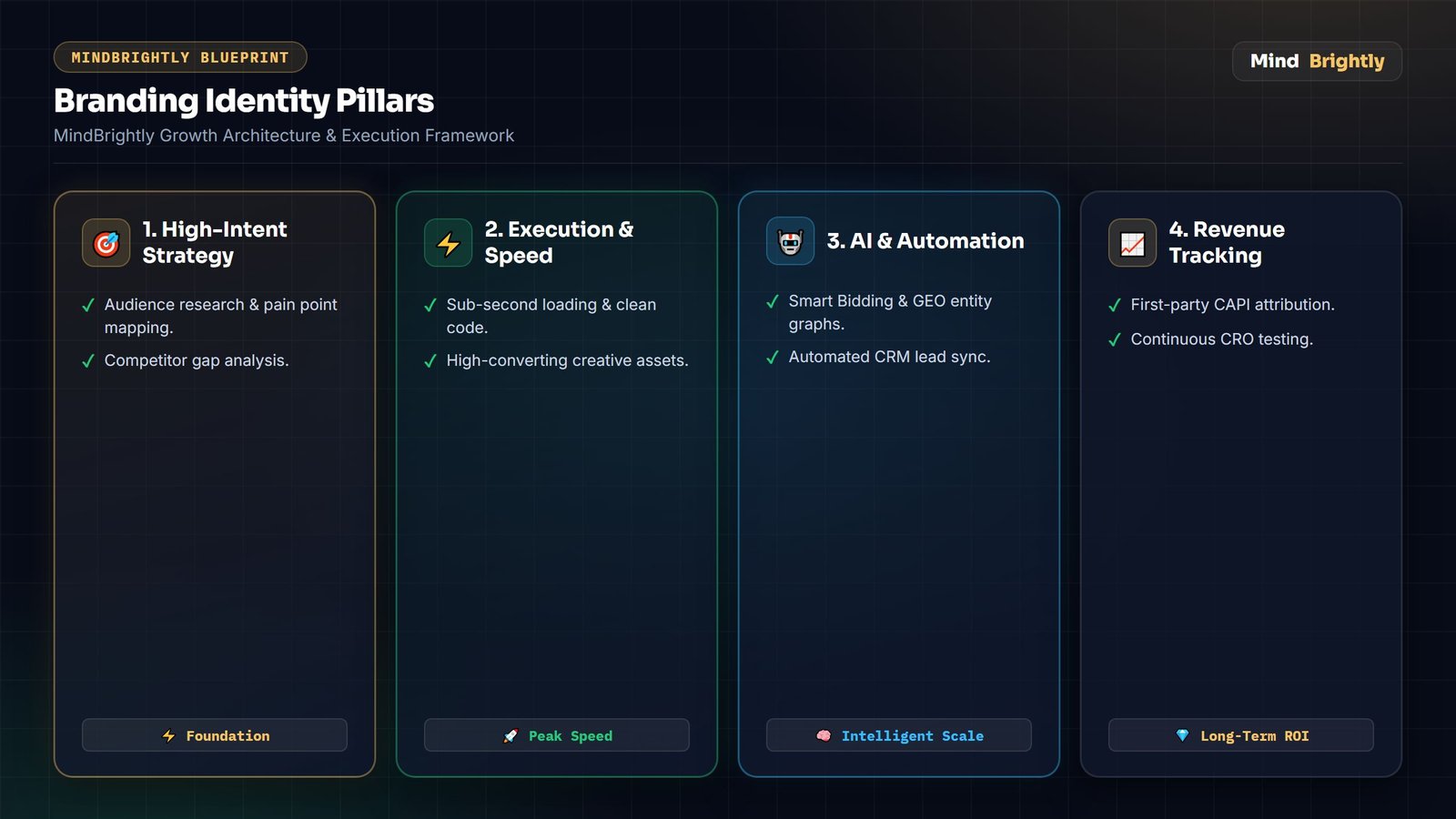
The Ultimate 2026 Framework for Dominating Digital Marketing
While the fundamentals of whatsapp marketing for small businesses guide remain crucial, the landscape has shifted violently due to Generative AI, privacy protocols (iOS 14.5+), and changing consumer psychology. In this exclusive deep-dive, we break down the exact technical frameworks MindBrightly uses to generate 10x ROI for our enterprise and local clients.
1. The Shift to Generative Engine Optimization (GEO)
Traditional Search Engine Optimization (SEO) was built on "Ten Blue Links." In 2026, over 65% of informational queries end in a "Zero-Click Search." Users ask a question, and Google AI Overviews, ChatGPT Search, or Perplexity AI instantly provide the answer without the user ever clicking your website.
To adapt your Digital Marketing strategy, you must transition to Generative Engine Optimization (GEO). AI models do not read websites like humans; they parse knowledge graphs and assess entity relationships.
- Entity Salience: Your brand must be recognized as a distinct entity in Google's Knowledge Graph, not just a keyword string.
- Information Gain: AI models penalize derivative content. Your articles must include proprietary data, original research, or unique expert quotes that exist nowhere else on the internet.
- Citation Formatting: Structuring your data in clean, semantic HTML tables and bullet points increases the likelihood of an AI tool citing you as the primary source in a summarized answer.
2. Defeating Signal Loss with Meta Conversions API (CAPI)
If your Digital Marketing campaigns rely solely on browser-based tracking (like the standard Meta Pixel or Google Analytics 4 client-side tags), you are bleeding budget. Browsers like Safari (ITP) and Firefox aggressively block third-party cookies, and iOS 14.5+ users overwhelmingly opt out of tracking.
The Solution: Server-Side Tracking. By implementing Google Tag Manager Server-Side (sGTM), the data flow changes entirely. Instead of the user's browser sending a signal to Facebook (which gets blocked), your web server directly sends a secure, hashed API payload to Meta's servers.
This recovers up to 40% of "lost" conversion data. When Meta's Advantage+ algorithms receive 40% more conversion signals, they exit the learning phase faster, drastically reducing your Cost Per Acquisition (CPA).
3. The B2B Playbook: Account-Based Marketing (ABM)
Applying B2C tactics to a B2B Digital Marketing strategy is the number one reason agencies fail. B2B sales cycles take 3 to 12 months, involve multiple stakeholders (CFO, CTO, Procurement), and have high ticket values. You cannot sell a $50,000 SaaS contract using a generic Facebook image ad.
MindBrightly utilizes Account-Based Marketing (ABM). We do not target "demographics"; we target specific companies.
- IP Identification: We identify the corporate IP addresses of your top 100 target accounts (e.g., Infosys HQ in Bangalore).
- Role-Based Targeting: We run LinkedIn Thought Leadership Ads exclusively to employees holding "Director" or "C-Level" titles within those specific IPs.
- High-Intent Lead Magnets: The ad creative is never "Buy our software." It is an interactive ROI Calculator or an in-depth Industry Whitepaper that requires a work email to access.
4. WhatsApp Automation & Zero-Friction Lead Nurturing
In the Indian market, email marketing is practically dead for B2C and struggling in B2B. With average open rates plummeting below 15%, relying on email autoresponders for your Digital Marketing campaigns will result in massive lead drop-off.
Enter the WhatsApp Cloud API. With a 98% open rate, WhatsApp is the ultimate conversion engine. When a prospect submits a lead form on your website or Meta Ad, our automated systems instantly (within 3 seconds) send them a personalized WhatsApp message.
- Instant Gratification: The message contains exactly what they requested (a PDF brochure, a pricing link, or a portfolio).
- Interactive Buttons: We use WhatsApp interactive UI (Quick Reply Buttons) to ask qualifying questions like "What is your budget?" or "Schedule a Call."
- AI Chatbot Handoff: If the user asks a complex question, our integrated AI chatbot answers them instantly based on your company's knowledge base, only handing over to a human agent when the prospect is ready to close.
5. Conversion Rate Optimization (CRO) & Core Web Vitals
Driving 10,000 visitors to a slow, unoptimized landing page is a waste of capital. Your Digital Marketing strategy is only as strong as your Conversion Rate.
Google's Core Web Vitals (CWV) algorithm update mandates that sites pass stringent speed tests. Specifically, your Largest Contentful Paint (LCP) must occur under 2.5 seconds, and your Interaction to Next Paint (INP) must be under 200 milliseconds.
To achieve this, we abandon bloated WordPress templates. We engineer custom architectures using tools like Vite and static-site generation. A site that loads in 0.8 seconds not only ranks higher organically but enjoys a significantly lower Cost Per Click (CPC) on Google Ads due to higher Quality Scores.
Take Your Digital Marketing to the Enterprise Level
Stop losing market share to competitors with inferior products but superior data pipelines.
Explore MindBrightly's Core Services & Industry Solutions
Core Growth Services
Industry Specific Marketing
Flawless Execution
Our WhatsApp Marketing for Small Businesses: What Actually Works Blueprint
We don't do guesswork. Every campaign follows a rigorous, data-driven framework designed to maximize ROI and eliminate wasted spend.
Deep Audit & Strategy
We analyze your current setup, spy on your top competitors, and identify exact conversion bottlenecks before spending a single rupee.
Technical Implementation
From Server-Side Tracking to robust Schema markup, we lay a flawless technical foundation so algorithms feed on perfect data.
Aggressive Scaling
Once we hit your target Cost Per Acquisition (CPA), we aggressively scale the budget using AI-bidding to dominate your market share.
FAQs About WhatsApp Marketing for Small Businesses: What Actually Works
Common questions we get from founders and marketing heads.
How long does it take to see ROI from WhatsApp Marketing for Small Businesses: What Actually Works? +
Do you require long-term lock-in contracts? +
How do you handle reporting and transparency? +
Ready to Dominate Your Local Market?
Stop guessing and start scaling. Let our Chandigarh-based team build a data-driven strategy that turns clicks into paying customers.