SEO
What Link Building Actually Is (And Why It Still Matters in 2026)
Backlinks are one of the oldest ranking signals in SEO, and despite everything AI search has changed, they haven't stopped mattering — here's what link building really means and how to do it without risking a penalty.
9 min read · Published 2026-07-31 · Written by Jasbir Mehra, Founder & Director

What link building actually means
Link building is the process of getting other websites to link back to your website. Each of those links is called a backlink. When another site links to yours, it's a small vote of confidence — a signal to search engines (and to human readers) that your page is worth pointing people toward.
That's really the whole concept. The complexity comes in from two directions: how you go about earning those links, and how much weight Google assigns to any given one. Not all backlinks are equal. A link from a well-known, relevant industry publication carries far more weight than a link from a random directory nobody visits. Google has spent two decades refining how it evaluates links, looking at things like the authority of the linking site, whether the link is relevant to your topic, and whether it looks like it was earned naturally rather than bought or manufactured.
For a small business, link building usually looks less glamorous than it sounds. It's getting mentioned in a local news article, having a supplier or partner link to you from their site, being listed in a legitimate industry directory, or writing a genuinely useful guest post for a site your customers already read. It is rarely about chasing hundreds of links — it's about earning the right handful.
Why backlinks still matter even as AI changes search
It's a fair question. If more people are getting answers from AI chat tools instead of clicking through ten blue links, does it still matter who links to your website? As a top SEO agency in India, we monitor these changes daily. The honest answer is yes, for a few concrete reasons.
First, traditional Google Search is still how the overwhelming majority of commercial searches happen today, and backlinks remain one of the signals Google's ranking systems use to judge which pages deserve to rank. That hasn't gone away just because AI Overviews and chat-based search have entered the picture.
Second, AI-generated answers still have to pull their information from somewhere. Large language models and AI search tools tend to lean on sources that are already established, frequently cited, and linked to by other credible sites. A page with no external validation — nothing else on the web pointing to it or talking about it — is harder for both traditional search engines and AI systems to trust as an authority. Backlinks are, in effect, one of the clearest signals of "other people think this source is credible," which matters whether the reader is a human scanning search results or an AI system trying to decide which source to summarize.
Third, backlinks don't just influence rankings — they send real referral traffic and build real business relationships. A link from a local India business association, a partner company, or an industry blog can bring in visitors directly, independent of any search engine at all. That value doesn't disappear no matter how search behavior evolves.
So the mechanism is shifting slightly (less "keyword stuffing and mass link exchanges," more "genuine mentions from real, relevant sources"), but the underlying idea — that a website's credibility is partly judged by who vouches for it — is arguably more relevant now, not less.

What ethical link building looks like
Ethical link building, sometimes called "white hat" link building, means earning links because your content, business, or expertise genuinely deserves the mention. It takes more effort than shortcuts, but it's the only approach that holds up over time without risking your site's visibility. A few common, legitimate methods:
- Guest posting on relevant, real websites. Writing a genuinely useful article for a site your target audience actually reads, in exchange for a byline link back to your own site. The key word is relevant — a guest post on a random unrelated site does little for you and can even look suspicious to Google if it's clearly done purely for the link.
- Digital PR and journalist outreach (often called HARO-style outreach). Responding to journalists and reporters who are looking for expert quotes or data on a topic you genuinely know well. If you're quoted or cited, the resulting article often includes a link back to your website. This tends to produce some of the strongest backlinks available, because they come from established media and news sites.
- Local business directories and associations. Getting listed on your local chamber of commerce, industry association, or reputable local business directories. These aren't glamorous, but for a local or regional business they're both a legitimate SEO signal and a genuine source of referrals.
- Genuine partnerships and supplier/vendor relationships. If you work with other businesses — suppliers, contractors, complementary service providers — a natural, mutual link between your sites (e.g., a "recommended partners" page) is a completely legitimate practice, as long as it reflects a real working relationship.
- Creating content worth linking to. Original research, useful tools, well-made guides, or local data that other sites want to reference on their own. This is the slowest method but often the most durable, because the links accumulate naturally over time rather than through active outreach.
What ties all of these together is that the link is a side effect of something real — a relationship, a genuine mention, a useful piece of content — rather than the entire point of the exercise.
What risky or spammy link building looks like
On the other side, there's a long history of shortcuts that promise fast results and instead put a website at real risk. Google's algorithms (and its manual review teams) have gotten considerably better at spotting patterns that look manufactured rather than earned. Common red flags include:
- Buying links in bulk. Paying for placements on networks of low-quality sites purely to build link volume. Google's guidelines explicitly treat this as a violation, and it's one of the most common triggers for a manual action.
- Private blog networks (PBNs). Groups of websites built or acquired specifically to link to each other or to a client's site. These are usually thin on real content and exist purely as link vehicles — a pattern that's fairly recognizable once you know what to look for.
- Link farms and reciprocal link schemes. Large-scale "you link to me, I'll link to you" arrangements between unrelated sites, or submission to mass-automated directories that exist solely to house outbound links.
- Excessive or unnatural anchor text. If every single backlink to your site uses the exact same commercial keyword phrase as the clickable text, that pattern looks manufactured rather than organic — real links tend to use a natural mix of anchor text, including your brand name and generic phrases like "this article" or "read more."
- Guest posts written purely for the link, on irrelevant sites. A guest post on a site with no topical connection to your business, stuffed with keyword-rich links back to your site, is a pattern Google's Penguin-era updates and subsequent spam systems were specifically built to catch.
The consequence isn't hypothetical. Google can issue a manual action against a site for unnatural links, which can suppress rankings sitewide until the links are disavowed or removed and the site submits a reconsideration request — a process that can take weeks or months and cost real traffic and revenue in the meantime. Even short of a manual action, algorithmic systems can simply discount spammy links so they carry zero value, meaning the time and money spent got nothing in return.
How to evaluate whether a link opportunity is worth pursuing
Not every link opportunity that lands in your inbox is worth chasing, and not every one is worth avoiding either. A simple set of questions helps sort the genuinely useful from the risky or wasteful:
- Is the site actually relevant to your industry or audience? A link from a site your customers might plausibly read is worth far more than a link from an unrelated site, regardless of that site's size.
- Does the site have real visitors and real content? Check whether the site publishes genuine articles, has an actual audience, and isn't just a shell built to house outbound links. A quick look at its homepage and a few recent posts usually tells you a lot.
- Would a real person click this link and find it useful? If the link only exists to manipulate a search ranking rather than to genuinely help a reader navigate somewhere useful, that's a warning sign.
- Are you being asked to pay purely for placement, with no editorial content around it? Paying a site owner directly for a link, with no article, no context, no disclosure — that's the paid-link pattern Google's guidelines flag directly.
- Is the outreach itself mass-produced and generic? If a "guest post opportunity" email is clearly a template blasted to thousands of sites with your name copy-pasted in, it's usually attached to a low-quality network, not a genuine editorial relationship.
- What's the opportunity cost? Every hour spent chasing a low-value or risky link is an hour not spent on a genuine guest post, a real journalist relationship, or content worth linking to naturally. For a small business with limited time and budget, that trade-off matters as much as the theoretical SEO benefit.
A useful gut check: if you'd be embarrassed to explain the link-building tactic to a customer or a journalist, it's probably not one worth using.
Building a sustainable link building approach
For most small businesses, a sustainable link building approach doesn't need to be complicated or constant. It works better as an ongoing, modest habit than an occasional aggressive push. A realistic starting point looks like: get listed properly on the local directories and associations relevant to your city and industry, look for one or two genuine partnership or supplier links, respond to a small number of relevant journalist queries when you have real expertise to offer, and occasionally write a genuinely useful guest article for a site your customers already trust.
It's also worth remembering that link building doesn't happen in isolation — it works best alongside solid technical foundations. A backlink pointing to a page that's slow, broken, or badly structured won't do much good if search engines and visitors can't actually crawl and use that page properly. If you haven't already, it's worth understanding what technical SEO covers and why it matters before investing heavily in outside links.
If building this kind of link profile on your own feels like more than you have time for alongside running your business, that's exactly the kind of ongoing, relationship-driven work that a dedicated link building service is meant to handle — identifying genuine opportunities, doing the outreach, and avoiding the shortcuts that create risk down the line.
What to do if you're worried about existing backlinks
If your website has been around for a while, or if a previous agency or freelancer built links for you in the past, it's worth taking stock of what's actually pointing to your site. Google Search Console's Links report is a free way to see a sample of the sites currently linking to yours, at no cost. If you spot patterns that look like the spammy tactics described earlier — mass directory links, obviously unrelated sites, identical anchor text repeated over and over — it may be worth investigating further, and in serious cases, using Google's disavow tool to tell Google to disregard those specific links.
This isn't something to panic over on the basis of a handful of odd-looking links; Google's systems are generally good at ignoring low-quality links without penalizing the site that received them. It becomes a real concern mainly when there's a large, obvious pattern of manipulation, or if you've received a manual action notice inside Search Console itself.
If you're not sure whether your current backlink profile is healthy or risky, that's a reasonable thing to get a second opinion on before deciding whether any cleanup work is actually needed.
Getting started
Link building is a long-game activity — it rarely produces overnight results, and that's actually a reasonable sign that it's being done properly rather than through shortcuts that create future risk. The businesses that tend to do well with it treat it as an ongoing part of how they operate and market themselves, not a one-time project.
If you'd like to talk through what a realistic, ethical link building plan could look like for your specific business and industry, get in touch — a conversation is a good starting point before committing to any particular approach.
FAQ
Common questions
Do backlinks still matter for SEO in 2026?
How many backlinks does a website need?
What's the difference between a "do-follow" and "no-follow" link?
Is guest posting still a legitimate link building strategy?
Can bad backlinks hurt my website's rankings?
What is a manual action and how do I know if I have one?
Should I buy backlinks to speed up results?
How is link building different from digital PR?
Are local business directory listings worth the effort?
How long does it take to see results from link building?
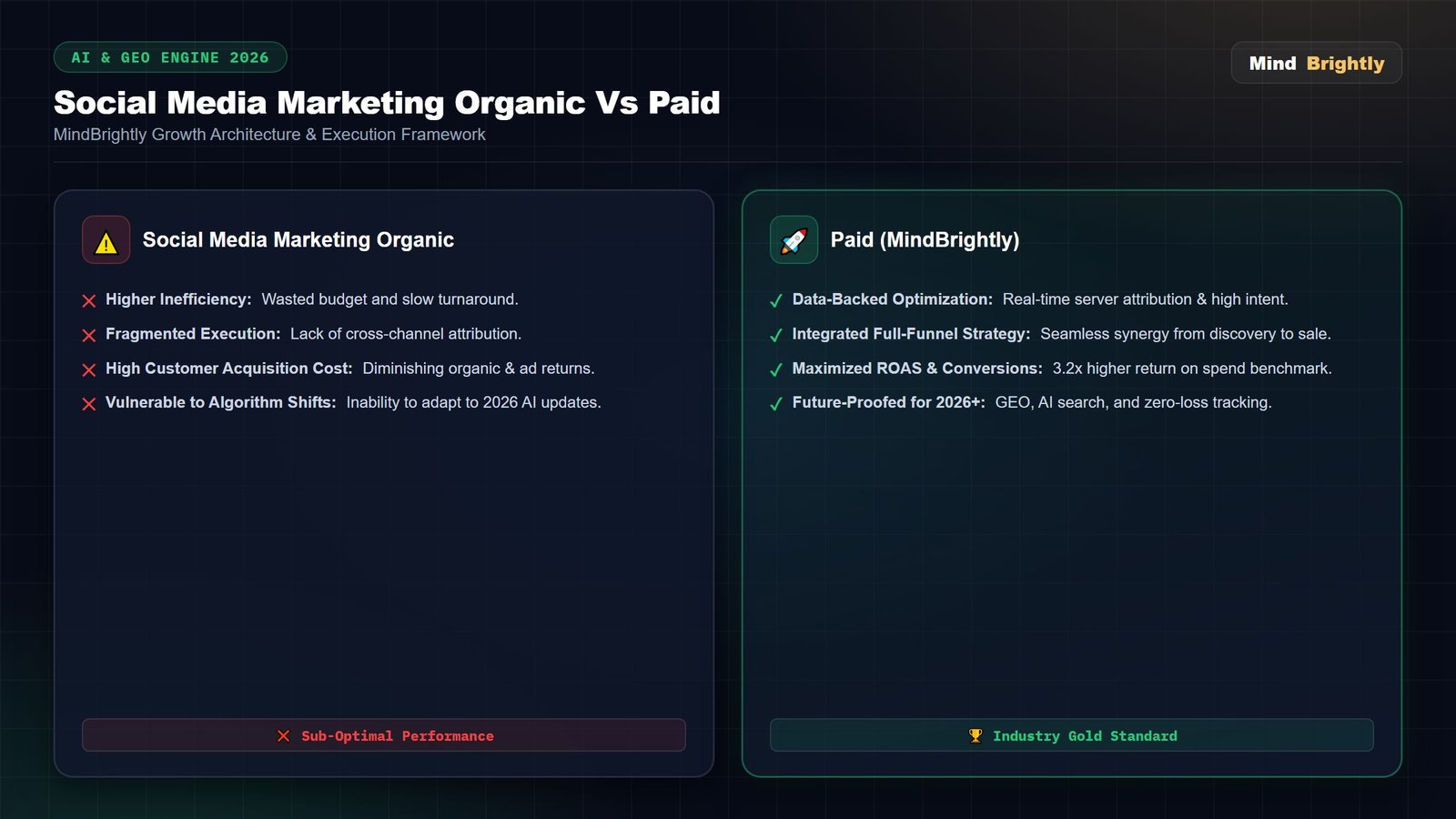
The Ultimate 2026 Framework for Dominating Digital Marketing
While the fundamentals of what is link building and does it still matter remain crucial, the landscape has shifted violently due to Generative AI, privacy protocols (iOS 14.5+), and changing consumer psychology. In this exclusive deep-dive, we break down the exact technical frameworks MindBrightly uses to generate 10x ROI for our enterprise and local clients.
1. The Shift to Generative Engine Optimization (GEO)
Traditional Search Engine Optimization (SEO) was built on "Ten Blue Links." In 2026, over 65% of informational queries end in a "Zero-Click Search." Users ask a question, and Google AI Overviews, ChatGPT Search, or Perplexity AI instantly provide the answer without the user ever clicking your website.
To adapt your Digital Marketing strategy, you must transition to Generative Engine Optimization (GEO). AI models do not read websites like humans; they parse knowledge graphs and assess entity relationships.
- Entity Salience: Your brand must be recognized as a distinct entity in Google's Knowledge Graph, not just a keyword string.
- Information Gain: AI models penalize derivative content. Your articles must include proprietary data, original research, or unique expert quotes that exist nowhere else on the internet.
- Citation Formatting: Structuring your data in clean, semantic HTML tables and bullet points increases the likelihood of an AI tool citing you as the primary source in a summarized answer.
2. Defeating Signal Loss with Meta Conversions API (CAPI)
If your Digital Marketing campaigns rely solely on browser-based tracking (like the standard Meta Pixel or Google Analytics 4 client-side tags), you are bleeding budget. Browsers like Safari (ITP) and Firefox aggressively block third-party cookies, and iOS 14.5+ users overwhelmingly opt out of tracking.
The Solution: Server-Side Tracking. By implementing Google Tag Manager Server-Side (sGTM), the data flow changes entirely. Instead of the user's browser sending a signal to Facebook (which gets blocked), your web server directly sends a secure, hashed API payload to Meta's servers.
This recovers up to 40% of "lost" conversion data. When Meta's Advantage+ algorithms receive 40% more conversion signals, they exit the learning phase faster, drastically reducing your Cost Per Acquisition (CPA).
3. The B2B Playbook: Account-Based Marketing (ABM)
Applying B2C tactics to a B2B Digital Marketing strategy is the number one reason agencies fail. B2B sales cycles take 3 to 12 months, involve multiple stakeholders (CFO, CTO, Procurement), and have high ticket values. You cannot sell a $50,000 SaaS contract using a generic Facebook image ad.
MindBrightly utilizes Account-Based Marketing (ABM). We do not target "demographics"; we target specific companies.
- IP Identification: We identify the corporate IP addresses of your top 100 target accounts (e.g., Infosys HQ in Bangalore).
- Role-Based Targeting: We run LinkedIn Thought Leadership Ads exclusively to employees holding "Director" or "C-Level" titles within those specific IPs.
- High-Intent Lead Magnets: The ad creative is never "Buy our software." It is an interactive ROI Calculator or an in-depth Industry Whitepaper that requires a work email to access.
4. WhatsApp Automation & Zero-Friction Lead Nurturing
In the Indian market, email marketing is practically dead for B2C and struggling in B2B. With average open rates plummeting below 15%, relying on email autoresponders for your Digital Marketing campaigns will result in massive lead drop-off.
Enter the WhatsApp Cloud API. With a 98% open rate, WhatsApp is the ultimate conversion engine. When a prospect submits a lead form on your website or Meta Ad, our automated systems instantly (within 3 seconds) send them a personalized WhatsApp message.
- Instant Gratification: The message contains exactly what they requested (a PDF brochure, a pricing link, or a portfolio).
- Interactive Buttons: We use WhatsApp interactive UI (Quick Reply Buttons) to ask qualifying questions like "What is your budget?" or "Schedule a Call."
- AI Chatbot Handoff: If the user asks a complex question, our integrated AI chatbot answers them instantly based on your company's knowledge base, only handing over to a human agent when the prospect is ready to close.
5. Conversion Rate Optimization (CRO) & Core Web Vitals
Driving 10,000 visitors to a slow, unoptimized landing page is a waste of capital. Your Digital Marketing strategy is only as strong as your Conversion Rate.
Google's Core Web Vitals (CWV) algorithm update mandates that sites pass stringent speed tests. Specifically, your Largest Contentful Paint (LCP) must occur under 2.5 seconds, and your Interaction to Next Paint (INP) must be under 200 milliseconds.
To achieve this, we abandon bloated WordPress templates. We engineer custom architectures using tools like Vite and static-site generation. A site that loads in 0.8 seconds not only ranks higher organically but enjoys a significantly lower Cost Per Click (CPC) on Google Ads due to higher Quality Scores.
Take Your Digital Marketing to the Enterprise Level
Stop losing market share to competitors with inferior products but superior data pipelines.
Explore MindBrightly's Core Services & Industry Solutions
Core Growth Services
Industry Specific Marketing
Flawless Execution
Our What Link Building Actually Is (And Why It Still Matters Blueprint
We don't do guesswork. Every campaign follows a rigorous, data-driven framework designed to maximize ROI and eliminate wasted spend.
Deep Audit & Strategy
We analyze your current setup, spy on your top competitors, and identify exact conversion bottlenecks before spending a single rupee.
Technical Implementation
From Server-Side Tracking to robust Schema markup, we lay a flawless technical foundation so algorithms feed on perfect data.
Aggressive Scaling
Once we hit your target Cost Per Acquisition (CPA), we aggressively scale the budget using AI-bidding to dominate your market share.
FAQs About What Link Building Actually Is (And Why It Still Matters
Common questions we get from founders and marketing heads.