SOCIAL MEDIA ADS
Instagram Ads vs Facebook Ads: How They Actually Differ
They share the same ad manager and the same targeting engine, but Instagram and Facebook are not the same audience, and treating them as identical is where a lot of ad budgets go to waste.
9 min read · Published 2026-07-31 · Written by Jasbir Mehra, Founder & Director

Same Backend, Different Audience
If you've ever set up a campaign in Meta Ads Manager, you know the drill: pick an objective, define an audience, choose a budget, and then tick boxes for where the ad should show up. Instagram and Facebook sit right next to each other in that placement list, both owned by Meta, both using the same targeting data, the same bidding system, and often the same creative. It's easy to assume that if the platform is the same, the results will be too.
They're not. Facebook and Instagram are different apps with different histories, different interface habits, and different reasons people open them. Facebook has been around since the mid-2000s and carries an older, broader user base along with a culture of groups, local community pages, marketplace browsing, and long-form text posts. Instagram grew up visual-first, built around photos, short video, and now heavily around Reels and Stories. People open Facebook to catch up, check groups, or browse Marketplace. They open Instagram to scroll, watch, and discover. Those are different mental states, and a different mental state changes how an ad gets received.
This doesn't mean one platform is "better." It means they behave like two different rooms in the same building, and a business that only ever furnishes one room is missing half the house.
Who You'll Actually Find on Each Platform
Neither platform publishes a precise breakdown of who is where by age, income, or profession, and we won't invent numbers that pretend otherwise. But there are consistent, widely observed tendencies worth knowing.
Facebook tends to skew toward an older and more settled user base — people managing households, running errands, participating in local community or neighborhood groups, buying and selling on Marketplace, and following pages for local services, schools, religious institutions, and civic updates. It's also still the default social network for a lot of small and mid-sized business owners themselves, which is part of why B2B and local-service advertisers often find a receptive audience there.
Instagram tends to skew younger and more visually driven, with heavy usage from people who follow creators, fashion and beauty brands, fitness accounts, food and travel content, and lifestyle influencers. It's a discovery-first platform: people are more used to encountering products they didn't search for and impulse-clicking on something that looks good in the moment.
Neither of these is a hard rule. Plenty of older users are active, engaged Instagram users, and plenty of younger users spend real time on Facebook Marketplace and groups. The point isn't to write anyone off — it's that the two platforms attract different intents, and your targeting should account for that rather than assuming one audience file works identically in both places.

Which Businesses Tend to Do Better Where
Because of those audience tendencies, certain kinds of businesses naturally find more traction on one platform, even while running through the same account.
Businesses that tend to perform well on Facebook Ads include local services (plumbers, clinics, salons, coaching centers, real estate agents), community-oriented businesses that benefit from groups and local page presence, businesses targeting an older or family-oriented demographic, and anything that relies on detailed information before a decision — think insurance, education programs, or higher-consideration B2B services where a longer post or a lead form fits naturally into how people already use the app.
Businesses that tend to perform well on Instagram Ads include fashion, beauty, and personal care brands, food and beverage businesses, fitness and wellness studios, home décor and lifestyle products, and anything visually strong enough to stop a thumb mid-scroll. Direct-to-consumer products with strong packaging or a clear "in-use" shot tend to do especially well here, because the platform rewards a fast, attractive visual over a long explanation.
Service businesses that are less visual by nature — accounting, legal services, industrial suppliers — often see more efficient results on Facebook simply because the format suits explanation better than a 15-second video does. Meanwhile, anything that photographs or films well almost always has an edge on Instagram, regardless of price point.
Again, these are tendencies, not laws. A well-run local restaurant can do very well on both; a niche software product can find its early adopters on Instagram just as easily as Facebook. The tendencies are a starting point for allocating budget, not a rule for excluding a platform entirely.
The Ad Formats Aren't the Same Experience
This is where the difference becomes most concrete, because the same campaign can look and behave very differently depending on where it lands.
Feed ads exist on both platforms and look fairly similar — an image or video with a caption, sitting between organic posts. But the surrounding content differs: a Facebook feed ad sits next to news shares, group updates, and text-heavy posts, while an Instagram feed ad sits next to polished photography and short videos, which raises the bar for how "finished" your creative needs to look to not feel out of place.
Stories are full-screen, vertical, and temporary by design, encouraging a more casual, in-the-moment feel — quick offers, behind-the-scenes clips, or a countdown to a sale. Stories are heavily used on Instagram and exist on Facebook too, but engagement habits around them differ, since Instagram users are more accustomed to swiping through Stories as a core part of using the app.
Reels are Meta's short-form vertical video format, built to compete with the kind of fast, entertaining, sound-on content that made short video popular in the first place. Reels placements are where the discovery effect is strongest — an ad can reach people who've never followed the brand and never searched for the product, purely because the content is engaging enough to hold attention for a few seconds. This format rewards native-feeling video (not a repurposed TV commercial) and tends to be a much bigger opportunity on Instagram than on Facebook, though Reels placements exist across both.
The practical takeaway: a single ad creative rarely performs equally well across all of these. A talking-head video that works in a Facebook feed can feel slow in a Reel. A trendy, fast-cut Reel can feel out of place next to a Facebook group post. Businesses that treat every placement as interchangeable usually leave performance on the table; the ones that adapt creative to the format tend to see the difference in cost per result.
Cost, Competition, and Buying Behavior
Ad costs on both platforms are driven by auction dynamics — how many advertisers are competing for the same audience at the same time — rather than a fixed price difference between the two apps. That said, a few patterns are worth knowing when planning budget.
Instagram's younger, discovery-driven audience often responds well to visually led impulse offers, which can suit products with a lower price point or a strong "see it, want it" moment. Facebook's audience, being more likely to browse with intent (searching Marketplace, joining a local group, looking for a service), can convert well on offers that involve more consideration — quotes, consultations, or higher-ticket purchases — provided the ad gives enough information to move someone toward a decision rather than just a quick glance.
Neither platform is inherently cheaper or more expensive in a way that holds true across every industry; it depends on how many other advertisers are chasing the same audience and how well the creative matches the placement. What is worth watching is which platform is actually producing leads or sales that turn into revenue, not just clicks or likes — and that's a business-by-business answer, not a universal one.
Why Most Businesses End Up Running Both
In practice, most businesses that advertise seriously on Meta don't pick one platform and stick to it — they run both, often within the same campaign, and let the algorithm distribute spend based on where it's finding results. There are a few practical reasons for this.
First, running both widens reach without much extra setup work, since the same ad account, audience targeting, and budget structure apply to both placements. Second, it hedges against the fact that no business can be completely certain in advance which platform its specific audience prefers — testing both and letting performance data decide is more reliable than guessing based on general tendencies. Third, Meta's own delivery system is built to shift budget toward whichever placement is performing better for a given ad set, which means manually restricting a campaign to only one platform can sometimes work against the very optimization the platform offers.
That doesn't mean "run both and ignore the differences." It means running both while paying attention to which platform each ad set, creative, and audience is actually working on — and adjusting creative for Reels versus feed versus Stories rather than assuming one version of an ad will do the job everywhere. For background on why Meta's ad ecosystem matters in the first place, our post on why Meta ads are important covers the bigger picture of why this platform remains central to most digital ad strategies.
How to Decide Where to Start
If budget is tight and a business genuinely has to choose a starting point rather than running both from day one, a few questions help narrow it down. Is the product highly visual, or does it need explanation? Visual products lean Instagram; explanation-heavy services lean Facebook. Is the target customer younger and more casual, or older and more settled? That leans Instagram or Facebook respectively, keeping in mind these are tendencies, not guarantees. Does the business rely on local community trust — reviews, groups, word of mouth? That leans Facebook. Does the brand have strong photography, video, or design assets ready to go? That leans Instagram, since weak creative performs especially poorly there.
Even with a clear starting point, the smarter long-term approach is to treat the first platform as a test bed, learn what messaging and creative actually convert, and then extend that learning to the other platform rather than staying permanently narrowed to one. Most businesses find that once they have creative and messaging that's working, adapting it for the second platform is a smaller lift than building from scratch — because the underlying value proposition remains the same, even if the presentation changes.
If you're trying to work out where your own budget should go — or you've already tried one platform and want a second opinion on what's working and what isn't — it's worth having a conversation before committing more spend. You can reach out through our contact page and we'll talk through what makes sense for your specific product and audience.
FAQ
Common questions
Is Instagram Ads more expensive than Facebook Ads?
Can I run the exact same ad on both platforms?
Should a B2B company advertise on Instagram at all?
What's the difference between Stories and Reels?
Does Instagram only work for younger audiences?
How much creative do I need before starting on Instagram vs Facebook?
Which platform is better for local businesses like restaurants or salons?
Do I need a separate ad account for Instagram and Facebook?
How do I know if my ads are performing better on one platform than the other?
Is it a mistake to only ever use automatic placements?
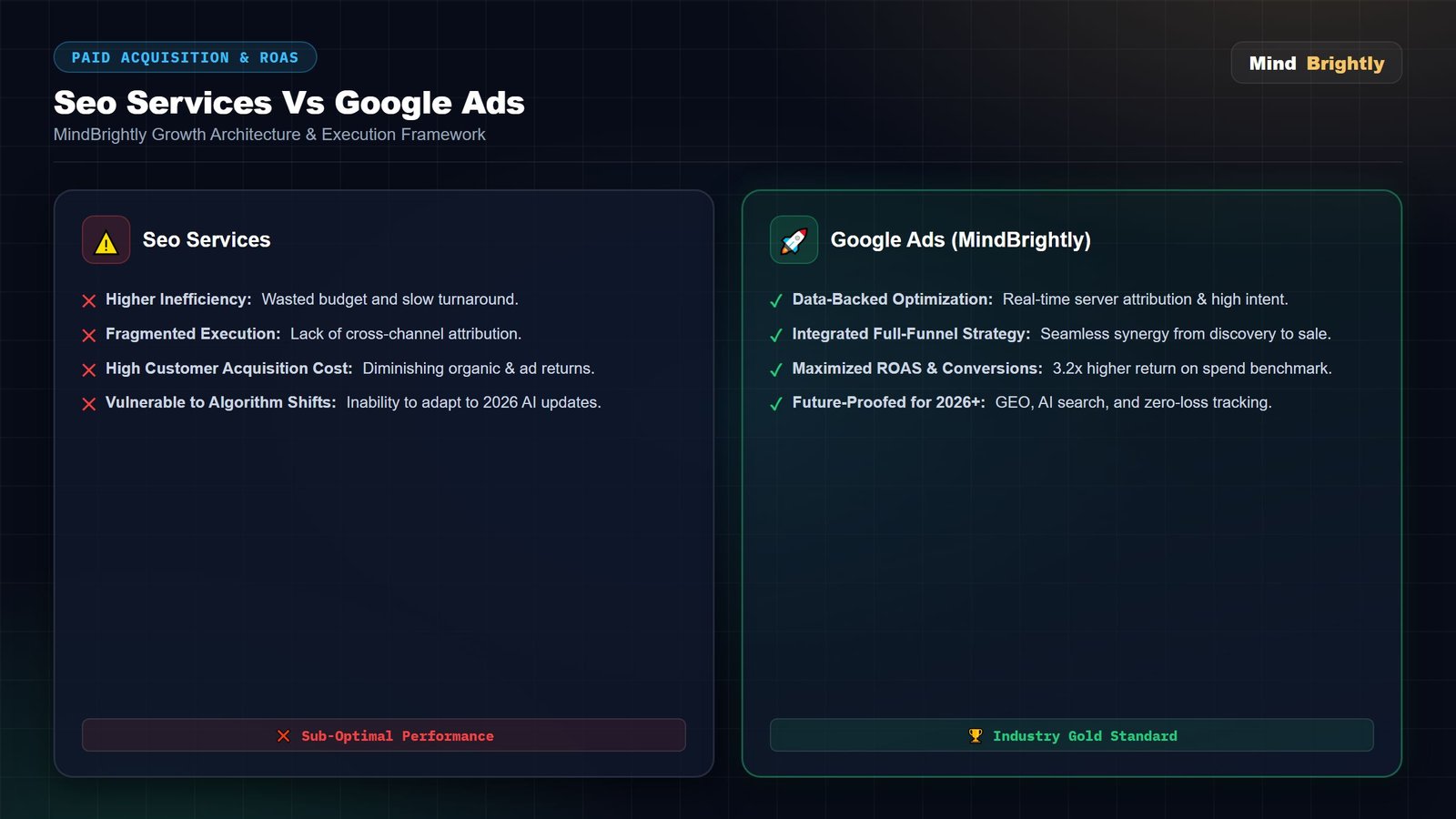
The Ultimate 2026 Framework for Dominating Performance Marketing
While the fundamentals of instagram ads vs facebook ads which platform fits remain crucial, the landscape has shifted violently due to Generative AI, privacy protocols (iOS 14.5+), and changing consumer psychology. In this exclusive deep-dive, we break down the exact technical frameworks MindBrightly uses to generate 10x ROI for our enterprise and local clients.
1. The Shift to Generative Engine Optimization (GEO)
Traditional Search Engine Optimization (SEO) was built on "Ten Blue Links." In 2026, over 65% of informational queries end in a "Zero-Click Search." Users ask a question, and Google AI Overviews, ChatGPT Search, or Perplexity AI instantly provide the answer without the user ever clicking your website.
To adapt your Performance Marketing strategy, you must transition to Generative Engine Optimization (GEO). AI models do not read websites like humans; they parse knowledge graphs and assess entity relationships.
- Entity Salience: Your brand must be recognized as a distinct entity in Google's Knowledge Graph, not just a keyword string.
- Information Gain: AI models penalize derivative content. Your articles must include proprietary data, original research, or unique expert quotes that exist nowhere else on the internet.
- Citation Formatting: Structuring your data in clean, semantic HTML tables and bullet points increases the likelihood of an AI tool citing you as the primary source in a summarized answer.
2. Defeating Signal Loss with Meta Conversions API (CAPI)
If your Performance Marketing campaigns rely solely on browser-based tracking (like the standard Meta Pixel or Google Analytics 4 client-side tags), you are bleeding budget. Browsers like Safari (ITP) and Firefox aggressively block third-party cookies, and iOS 14.5+ users overwhelmingly opt out of tracking.
The Solution: Server-Side Tracking. By implementing Google Tag Manager Server-Side (sGTM), the data flow changes entirely. Instead of the user's browser sending a signal to Facebook (which gets blocked), your web server directly sends a secure, hashed API payload to Meta's servers.
This recovers up to 40% of "lost" conversion data. When Meta's Advantage+ algorithms receive 40% more conversion signals, they exit the learning phase faster, drastically reducing your Cost Per Acquisition (CPA).
3. The B2B Playbook: Account-Based Marketing (ABM)
Applying B2C tactics to a B2B Performance Marketing strategy is the number one reason agencies fail. B2B sales cycles take 3 to 12 months, involve multiple stakeholders (CFO, CTO, Procurement), and have high ticket values. You cannot sell a $50,000 SaaS contract using a generic Facebook image ad.
MindBrightly utilizes Account-Based Marketing (ABM). We do not target "demographics"; we target specific companies.
- IP Identification: We identify the corporate IP addresses of your top 100 target accounts (e.g., Infosys HQ in Bangalore).
- Role-Based Targeting: We run LinkedIn Thought Leadership Ads exclusively to employees holding "Director" or "C-Level" titles within those specific IPs.
- High-Intent Lead Magnets: The ad creative is never "Buy our software." It is an interactive ROI Calculator or an in-depth Industry Whitepaper that requires a work email to access.
4. WhatsApp Automation & Zero-Friction Lead Nurturing
In the Indian market, email marketing is practically dead for B2C and struggling in B2B. With average open rates plummeting below 15%, relying on email autoresponders for your Performance Marketing campaigns will result in massive lead drop-off.
Enter the WhatsApp Cloud API. With a 98% open rate, WhatsApp is the ultimate conversion engine. When a prospect submits a lead form on your website or Meta Ad, our automated systems instantly (within 3 seconds) send them a personalized WhatsApp message.
- Instant Gratification: The message contains exactly what they requested (a PDF brochure, a pricing link, or a portfolio).
- Interactive Buttons: We use WhatsApp interactive UI (Quick Reply Buttons) to ask qualifying questions like "What is your budget?" or "Schedule a Call."
- AI Chatbot Handoff: If the user asks a complex question, our integrated AI chatbot answers them instantly based on your company's knowledge base, only handing over to a human agent when the prospect is ready to close.
5. Conversion Rate Optimization (CRO) & Core Web Vitals
Driving 10,000 visitors to a slow, unoptimized landing page is a waste of capital. Your Performance Marketing strategy is only as strong as your Conversion Rate.
Google's Core Web Vitals (CWV) algorithm update mandates that sites pass stringent speed tests. Specifically, your Largest Contentful Paint (LCP) must occur under 2.5 seconds, and your Interaction to Next Paint (INP) must be under 200 milliseconds.
To achieve this, we abandon bloated WordPress templates. We engineer custom architectures using tools like Vite and static-site generation. A site that loads in 0.8 seconds not only ranks higher organically but enjoys a significantly lower Cost Per Click (CPC) on Google Ads due to higher Quality Scores.
Take Your Performance Marketing to the Enterprise Level
Stop losing market share to competitors with inferior products but superior data pipelines.
Explore MindBrightly's Core Services & Industry Solutions
Core Growth Services
Industry Specific Marketing
Flawless Execution
Our Instagram Ads vs Facebook Ads: How They Actually Differ Blueprint
We don't do guesswork. Every campaign follows a rigorous, data-driven framework designed to maximize ROI and eliminate wasted spend.
Deep Audit & Strategy
We analyze your current setup, spy on your top competitors, and identify exact conversion bottlenecks before spending a single rupee.
Technical Implementation
From Server-Side Tracking to robust Schema markup, we lay a flawless technical foundation so algorithms feed on perfect data.
Aggressive Scaling
Once we hit your target Cost Per Acquisition (CPA), we aggressively scale the budget using AI-bidding to dominate your market share.
FAQs About Instagram Ads vs Facebook Ads: How They Actually Differ
Common questions we get from founders and marketing heads.