CONTENT
How to Write Website Copy People Actually Act On
Most website copy fails not because it's badly written, but because it's written for the wrong reader in the wrong way. Here's how to fix that, section by section.
9 min read · Published 2026-07-31 · Written by Jasbir Mehra, Founder & Director

Why most website copy doesn't work
Open ten small business websites right now and you'll find a familiar pattern: a hero banner with a vague tagline, three paragraphs about "who we are," a list of services with no explanation of what they actually do for the visitor, and a contact form buried at the bottom. The writing might be grammatically perfect. It still won't convert.
The problem is rarely spelling or sentence structure. It's that the copy is written from the business's point of view instead of the visitor's. It describes what the company does instead of what the visitor gets. It assumes people will read carefully instead of assuming they'll skim for ten seconds and leave. And it often gives the visitor five different things to do instead of one obvious next step.
None of this requires a copywriting degree to fix. It requires a shift in habit: before you write a single sentence, decide who is reading it, what they're worried about, and what one action you want them to take. Everything below is built around that shift.
Start with a value proposition, not a slogan
A value proposition answers one question in plain language: what does this visitor get, and why should they get it from you instead of someone else? It is not a slogan. Slogans are memorable phrases designed for brand recall over years of repeated exposure — think of a soft drink tagline. A value proposition has to work in the first five seconds a stranger lands on your homepage, with zero prior context.
Compare these two headlines for a home cleaning service:
- Clever but vague: "Bringing Sparkle Back Into Your Life"
- Clear and specific: "Reliable Home Cleaning in India, Booked in Under 2 Minutes"
The second one tells a visitor exactly what they get (reliable cleaning), where (India — relevant if that's your service area), and removes a hidden objection (booking is a hassle) before it's even raised. It's not clever, and it doesn't need to be. It needs to be understood instantly by someone who has never heard of your business.
A useful test: read your homepage headline out loud to someone unfamiliar with your business and ask them to tell you, in their own words, what you do and who it's for. If they hesitate or guess wrong, the headline isn't doing its job, no matter how nicely it reads.

Write for scanners, not readers
Eye-tracking research on web reading behaviour (most famously from the Nielsen Norman Group) has shown for years that people scan pages in an F-shaped or zigzag pattern rather than reading top to bottom. They read the first line or two of a section, glance down the left edge for headings and bullets, and only slow down to read fully if something catches their attention. Assume this is happening on your site too.
Practical ways to write for scanners:
- Front-load the important word or benefit at the start of a sentence or heading, not the end.
- Break long paragraphs into two or three short ones. A wall of text gets skipped entirely.
- Use subheadings that make sense on their own — someone should be able to skim just your subheadings and understand the gist of the page.
- Turn feature lists into bullets instead of burying them in a paragraph.
- Bold the one phrase per paragraph that matters most, sparingly — if everything is bold, nothing is.
Here's a before-and-after of a typical "About Us" opening paragraph:
Before: "Founded with a passion for excellence, our company has always believed in delivering the highest quality of service to each and every one of our valued clients, no matter how big or small the project may be."
After: "We fix plumbing problems the same day you call — no callback queues, no guessing games."
The second version says less, but a scanning visitor actually absorbs it. The first sounds nice and communicates almost nothing specific.
Benefit-led headlines beat clever ones, almost every time
Clever headlines rely on wordplay, puns, or intrigue. They can work brilliantly in advertising campaigns with heavy repeat exposure and brand budgets behind them. On a website, where a first-time visitor has no context and no patience, clever usually loses to clear.
A benefit-led headline states the outcome the visitor cares about, directly. It doesn't try to be witty first and informative second.
- Clever: "Your Business, Unlocked."
- Benefit-led: "Get Found on Google Without Hiring a Full Marketing Team"
- Clever: "Growth Happens Here."
- Benefit-led: "More Enquiries From Your Website, Without Increasing Ad Spend"
This doesn't mean your writing has to be boring. You can still have personality, tone, and voice — but the headline's job is to be understood instantly, not admired. Save the personality for the supporting sentence underneath it, where you have a little more room to be interesting once the core message has already landed.
If you're not confident writing this way for your own business, it's often worth getting outside eyes on it — a service like MindBrightly's website content writing work exists largely to translate "what we do" into "what the visitor gets," which is harder to do objectively about your own company than it sounds.
One page, one call-to-action
A common mistake on small business websites is offering the visitor too many choices at once: "Call us," "Book a demo," "Download our brochure," "Follow us on Instagram," and "Sign up for our newsletter," all on the same page, often in the same section. Every extra option is a small tax on the visitor's attention, and when people are asked to choose between several actions, a common outcome is that they choose none.
The fix is to decide, per page, what the single most important next step is — and then make everything else secondary or remove it entirely from that page.
- On a service page, the main CTA is usually "Get a quote" or "Book a call."
- On a blog post, the main CTA might be "Read a related article" or a soft nudge toward a relevant service.
- On a pricing page, it's almost always "Start" or "Contact us," not five competing buttons.
Secondary actions (social links, newsletter signup) can still exist, but they should visually recede — smaller, in a footer, or after the main CTA — so they don't compete with the one decision you actually want the visitor to make.
Address objections instead of hoping visitors won't have them
Every visitor arrives with unspoken doubts: Is this expensive? Will it actually work for a business like mine? What if I don't like the result? What happens if something goes wrong? Copy that ignores these questions leaves the visitor to answer them alone — usually by leaving and comparing you to a competitor instead.
Good copy names the objection and answers it directly, in plain language, near the point where the visitor would naturally think of it:
- Instead of silence on pricing: "Plans start at ₹X/month — no setup fee, cancel anytime."
- Instead of vague reassurance: "Not sure if this fits your industry? Here's what's included and what isn't."
- Instead of hiding the process: "Here's exactly what happens after you submit the form: we call within one business day, no obligation."
You don't need fabricated guarantees or invented statistics to do this — in fact, made-up numbers or vague "trusted by many" claims tend to erode trust faster than saying nothing, because sharp readers notice when a claim can't be backed up. Being specific and honest about what you actually offer does more work than any persuasive flourish.
If you're unsure which objections matter most for your business, look at your actual sales conversations or support emails — the questions people ask you before buying are the objections your copy should be answering.
Where AI writing tools genuinely help — and where they don't
AI writing tools are a legitimate first-draft aid. They're useful for getting past a blank page, generating multiple headline variations quickly, restructuring a rambling paragraph, or producing a rough outline for a service page you haven't started yet. Used this way, they save real time.
Where they fall short is anywhere accuracy or voice matters:
- Factual accuracy: AI tools can generate confident-sounding claims, statistics, or specifics that are wrong or entirely invented. Every number, guarantee, or claim about your own business needs a human to verify it before it goes live.
- Voice and nuance: AI drafts tend toward a generic, slightly promotional tone that reads similarly across thousands of other websites using the same tools. If your business has a specific personality — direct, warm, no-nonsense, whatever it is — that has to be edited in by someone who knows the business.
- Local and situational context: AI tools don't know your actual pricing, your actual turnaround times, or what your customers in your specific city or industry actually care about. Generic placeholders slip through if nobody checks.
A workable process: use AI to generate a rough first draft or headline options, then have a human — ideally someone close to the business — rewrite it for accuracy, tone, and specificity before publishing. Treat the AI output as raw material, not a finished page.
A simple checklist before you publish
Before any page goes live, run it through a short checklist:
- Can a stranger explain what you do and who it's for after reading only the headline and subhead?
- Does the page have exactly one primary call-to-action, clearly the most prominent element?
- Have you answered the two or three objections a visitor is most likely to have?
- Is every claim on the page something you can actually back up?
- Would the page still make sense to someone who only reads the headings and bullets?
If you write your own site copy but want a second opinion, or would simply rather hand the whole thing to someone who does this daily, MindBrightly's contact page is the fastest way to start that conversation — no pressure, just a chat about what your site needs. And if you haven't yet convinced yourself (or a co-founder) that any of this is worth the effort, our piece on why a website matters for a small business is a useful companion read.
FAQ
Common questions
What's the difference between website copy and content?
How long should my homepage copy be?
Should every page have a different call-to-action?
Is it okay to use humor or personality in website copy?
How do I figure out what objections my visitors actually have?
Can I just use ChatGPT to write my whole website?
What's a value proposition, in simple terms?
How many CTAs are too many on one page?
Does making copy shorter always improve conversions?
When should I get a professional to rewrite my website copy instead of doing it myself?
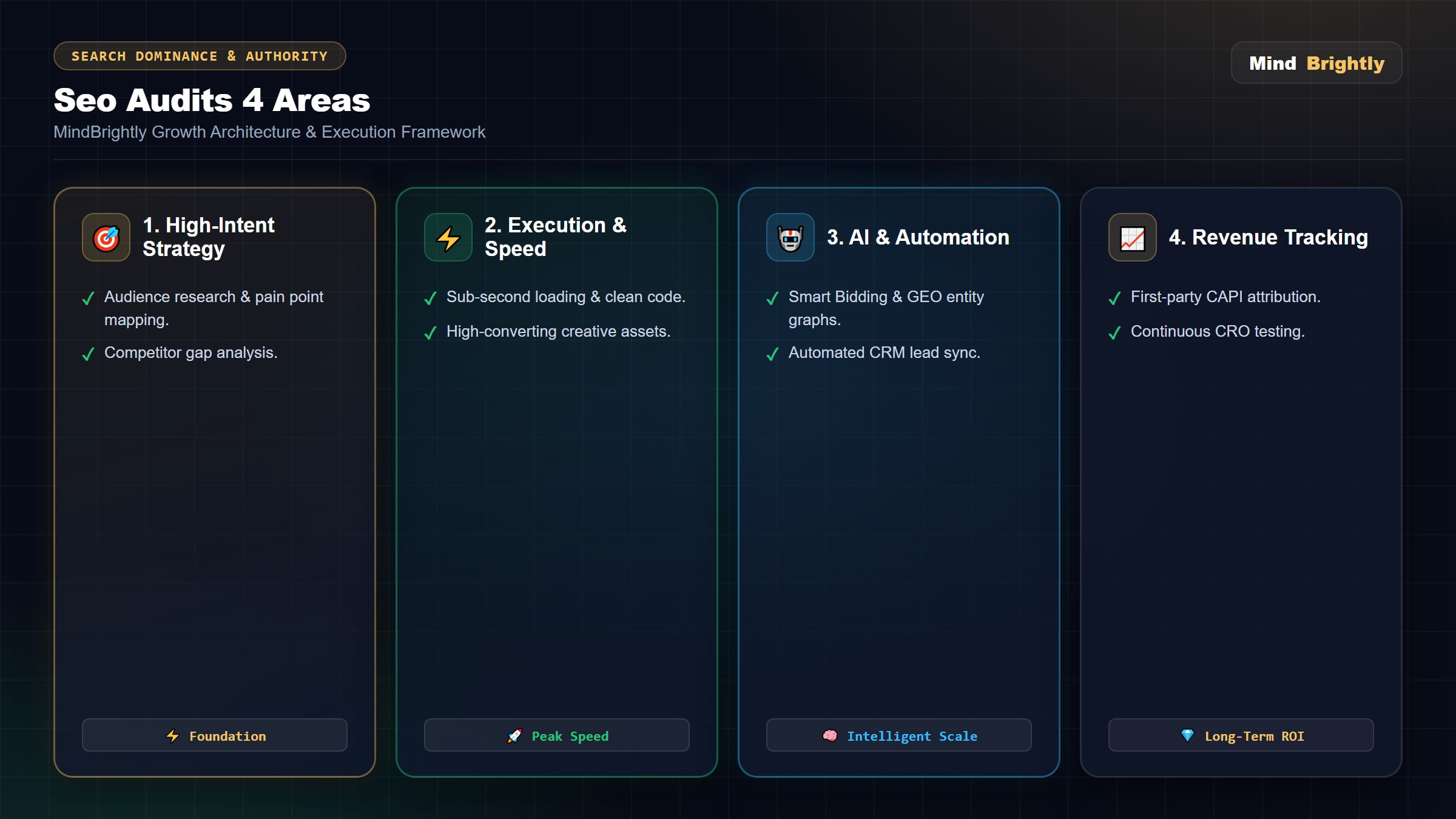
The Ultimate 2026 Framework for Dominating Web Performance & CRO
While the fundamentals of how to write website content that converts remain crucial, the landscape has shifted violently due to Generative AI, privacy protocols (iOS 14.5+), and changing consumer psychology. In this exclusive deep-dive, we break down the exact technical frameworks MindBrightly uses to generate 10x ROI for our enterprise and local clients.
1. The Shift to Generative Engine Optimization (GEO)
Traditional Search Engine Optimization (SEO) was built on "Ten Blue Links." In 2026, over 65% of informational queries end in a "Zero-Click Search." Users ask a question, and Google AI Overviews, ChatGPT Search, or Perplexity AI instantly provide the answer without the user ever clicking your website.
To adapt your Web Performance & CRO strategy, you must transition to Generative Engine Optimization (GEO). AI models do not read websites like humans; they parse knowledge graphs and assess entity relationships.
- Entity Salience: Your brand must be recognized as a distinct entity in Google's Knowledge Graph, not just a keyword string.
- Information Gain: AI models penalize derivative content. Your articles must include proprietary data, original research, or unique expert quotes that exist nowhere else on the internet.
- Citation Formatting: Structuring your data in clean, semantic HTML tables and bullet points increases the likelihood of an AI tool citing you as the primary source in a summarized answer.
2. Defeating Signal Loss with Meta Conversions API (CAPI)
If your Web Performance & CRO campaigns rely solely on browser-based tracking (like the standard Meta Pixel or Google Analytics 4 client-side tags), you are bleeding budget. Browsers like Safari (ITP) and Firefox aggressively block third-party cookies, and iOS 14.5+ users overwhelmingly opt out of tracking.
The Solution: Server-Side Tracking. By implementing Google Tag Manager Server-Side (sGTM), the data flow changes entirely. Instead of the user's browser sending a signal to Facebook (which gets blocked), your web server directly sends a secure, hashed API payload to Meta's servers.
This recovers up to 40% of "lost" conversion data. When Meta's Advantage+ algorithms receive 40% more conversion signals, they exit the learning phase faster, drastically reducing your Cost Per Acquisition (CPA).
3. The B2B Playbook: Account-Based Marketing (ABM)
Applying B2C tactics to a B2B Web Performance & CRO strategy is the number one reason agencies fail. B2B sales cycles take 3 to 12 months, involve multiple stakeholders (CFO, CTO, Procurement), and have high ticket values. You cannot sell a $50,000 SaaS contract using a generic Facebook image ad.
MindBrightly utilizes Account-Based Marketing (ABM). We do not target "demographics"; we target specific companies.
- IP Identification: We identify the corporate IP addresses of your top 100 target accounts (e.g., Infosys HQ in Bangalore).
- Role-Based Targeting: We run LinkedIn Thought Leadership Ads exclusively to employees holding "Director" or "C-Level" titles within those specific IPs.
- High-Intent Lead Magnets: The ad creative is never "Buy our software." It is an interactive ROI Calculator or an in-depth Industry Whitepaper that requires a work email to access.
4. WhatsApp Automation & Zero-Friction Lead Nurturing
In the Indian market, email marketing is practically dead for B2C and struggling in B2B. With average open rates plummeting below 15%, relying on email autoresponders for your Web Performance & CRO campaigns will result in massive lead drop-off.
Enter the WhatsApp Cloud API. With a 98% open rate, WhatsApp is the ultimate conversion engine. When a prospect submits a lead form on your website or Meta Ad, our automated systems instantly (within 3 seconds) send them a personalized WhatsApp message.
- Instant Gratification: The message contains exactly what they requested (a PDF brochure, a pricing link, or a portfolio).
- Interactive Buttons: We use WhatsApp interactive UI (Quick Reply Buttons) to ask qualifying questions like "What is your budget?" or "Schedule a Call."
- AI Chatbot Handoff: If the user asks a complex question, our integrated AI chatbot answers them instantly based on your company's knowledge base, only handing over to a human agent when the prospect is ready to close.
5. Conversion Rate Optimization (CRO) & Core Web Vitals
Driving 10,000 visitors to a slow, unoptimized landing page is a waste of capital. Your Web Performance & CRO strategy is only as strong as your Conversion Rate.
Google's Core Web Vitals (CWV) algorithm update mandates that sites pass stringent speed tests. Specifically, your Largest Contentful Paint (LCP) must occur under 2.5 seconds, and your Interaction to Next Paint (INP) must be under 200 milliseconds.
To achieve this, we abandon bloated WordPress templates. We engineer custom architectures using tools like Vite and static-site generation. A site that loads in 0.8 seconds not only ranks higher organically but enjoys a significantly lower Cost Per Click (CPC) on Google Ads due to higher Quality Scores.
Take Your Web Performance & CRO to the Enterprise Level
Stop losing market share to competitors with inferior products but superior data pipelines.
Explore MindBrightly's Core Services & Industry Solutions
Core Growth Services
Industry Specific Marketing
Flawless Execution
Our How to Write Website Copy People Actually Act On Blueprint
We don't do guesswork. Every campaign follows a rigorous, data-driven framework designed to maximize ROI and eliminate wasted spend.
Deep Audit & Strategy
We analyze your current setup, spy on your top competitors, and identify exact conversion bottlenecks before spending a single rupee.
Technical Implementation
From Server-Side Tracking to robust Schema markup, we lay a flawless technical foundation so algorithms feed on perfect data.
Aggressive Scaling
Once we hit your target Cost Per Acquisition (CPA), we aggressively scale the budget using AI-bidding to dominate your market share.
FAQs About How to Write Website Copy People Actually Act On
Common questions we get from founders and marketing heads.