SOCIAL MEDIA MARKETING
How Often Should You Actually Post on Social Media?
There's no magic number that works for every business — but there is a sustainable rhythm that beats both burnout and silence, and this guide will help you find it.
9 min read · Published 2026-07-31 · Written by Jasbir Mehra, Founder & Director

Why This Question Doesn't Have a Clean Answer
If you've searched for "how often should I post on social media," you've probably found a dozen contradictory answers. One article says post daily. Another says three times a week is enough. A third says it depends entirely on the platform's algorithm that month. All of them sound confident, and none of them are talking about your business specifically.
Here's the honest starting point: there is no universal number that fits a bakery in India, a B2B consultancy, and a boutique clothing brand equally well. What matters far more than hitting a specific frequency is whether you can sustain whatever rhythm you pick for months, not weeks. A business that posts four times a week for a year will almost always outperform one that posts daily for three weeks and then goes quiet for two months.
So instead of chasing a frequency number pulled from a generic blog post, this guide is built around a different question: what posting rhythm can you actually keep up, and how do you build the systems to keep up with it?
Consistency Beats Frequency, Every Time
Social platforms reward accounts that show up in a pattern their audience can rely on. This isn't about tricking an algorithm — it's simpler than that. People build a habit of checking accounts that post reliably, and they forget about accounts that appear sporadically. If you post seven days in a row and then vanish for three weeks, you're not just losing momentum, you're actively training your audience to stop expecting to see you.
Inconsistent posting also makes it harder to judge what's working. If you post twice one week and eight times the next, you can't meaningfully compare engagement, because you've changed too many variables at once. A steady cadence gives you a baseline you can actually learn from over time — which posts perform better, what times work best, which topics your audience responds to.
The practical implication is this: pick a frequency you're confident you can maintain even during your busiest month, not your calmest one. It is far better to commit to three solid posts a week and hit that number every single week than to promise yourself daily posting and quietly abandon it by week three.

A Realistic Cadence by Platform
Different platforms have different rhythms, largely because they serve different purposes in how people use them. Here's a grounded, non-fabricated way to think about each of the main ones a small business is likely to use.
Instagram rewards a mix of content types and reasonably frequent posting, because the app's discovery surfaces (like Explore and Reels) favor accounts that give them a steady stream to work with. For most small businesses, 3 to 5 feed posts a week, supplemented with Stories a few times a week, is a realistic and sustainable target. Reels can be added on top when you have the capacity, since short video tends to get pushed to non-followers more readily than static posts — but a business that can only manage 3 solid feed posts a week is in a far better position than one that promises daily Reels and burns out by month two.
Facebook has shifted heavily toward groups, video, and community-style content, and organic reach for standard business page posts has generally declined over the years. That makes raw frequency less important here than relevance — 2 to 4 posts a week tends to be enough for most small businesses, especially if the account is also used to respond to messages, reviews, and comments, which matters as much as the posts themselves on this platform.
LinkedIn works differently again. It's a slower-scrolling, more text-and-thought-driven platform, and audiences there tend to respond well to fewer, more substantial posts rather than frequent short ones. 2 to 3 posts a week is a sensible range for most small businesses and solo professionals — enough to stay visible without flooding a feed that people often check less frequently than Instagram or Facebook.
These ranges are starting points, not laws. The right number for your business also depends on your team's bandwidth, your industry, and how much genuinely useful content you can produce without resorting to filler. Our social media marketing team typically works with clients to set a cadence per platform that matches both their audience's habits and their actual production capacity, then adjusts it based on what the data shows over a few months.
The Burnout Trap — And Why It's So Common
Most small business owners who struggle with social media consistency don't fail because they don't understand its value. They fail because they set an unrealistic pace in a burst of motivation — often right after reading one of those "post daily for growth" articles — and then real life gets in the way. A busy sales week, a staffing gap, a personal emergency, and suddenly there's no post for ten days. The account goes quiet, and starting back up feels harder than if it had never stopped, because now there's a visible gap to explain.
This boom-and-bust pattern is worse for a business than simply picking a modest, steady frequency from day one. An audience that sees a business post reliably twice a week develops a habit of checking in. An audience that sees a business post daily for a month and then nothing for six weeks starts to wonder if the business closed down. Silence on social media reads, fairly or not, as a signal that something is wrong — slow business, disorganisation, or worse.
The fix isn't more willpower. It's picking a frequency low enough that it survives your worst weeks, not just your best ones. If you can only realistically manage two solid posts a week during a busy month, plan around two, and treat anything extra as a bonus rather than the baseline. A modest, unbroken cadence builds more trust over a year than an ambitious one that keeps collapsing.
Quality Still Comes First — Frequency Is the Container, Not the Content
None of this is an argument for posting more just for the sake of a number. A feed of five weak, generic posts a week will do less for a business than three posts that are genuinely useful, well-shot, or specific to what that business actually does. Frequency is the container that holds your content strategy together — it's not a substitute for having something worth saying.
Before locking in a posting frequency, it's worth being honest about what you can consistently produce without padding. Can you realistically photograph your product, write a caption, and post four times a week indefinitely? Or would three times a week, done properly, serve you better than five times a week done half-heartedly? There's no penalty for choosing the lower, more sustainable number — the platforms don't punish accounts for posting three times instead of five, but audiences do notice when content starts feeling like filler.
This is also where a lot of small businesses get the emphasis backwards. They worry intensely about hitting a frequency target and treat the actual message, offer, or story in each post as an afterthought. It's worth flipping that: decide what you actually want to say this month — a new product, a client story, an answer to a common question, a look behind the scenes — and let the number of things you have to say guide how often you post, within a realistic range for the platform.
How Batching and Planning Remove the Daily Scramble
The single biggest reason small businesses fall off a posting schedule isn't lack of ideas — it's the daily pressure of having to think of something, shoot it, write it, and post it, over and over, on top of running the actual business. Batching breaks that cycle by separating the creative work from the daily publishing work.
In practice, batching means setting aside a block of time — a couple of hours every week or two — to plan and produce several posts at once. You might shoot five product photos in one sitting, write captions for the week in one focused session, or record three short videos back to back while the lighting and setup are already in place. Once that content exists, publishing it becomes a five-minute task each day instead of a from-scratch project.
Planning tools make this even more sustainable. A simple content calendar — even a shared spreadsheet or a free scheduling tool — lets you see the month at a glance, spot gaps before they become weeks of silence, and schedule posts in advance so they go out even on days you're too busy to think about social media at all. Scheduling doesn't make content less authentic; it just removes the daily willpower requirement, which is where most consistency efforts quietly die.
A basic system worth trying: block two hours every other week for planning and content creation, use a scheduling tool (many have free tiers) to queue posts for the platforms you use, and leave a small buffer of "evergreen" posts — tips, FAQs, behind-the-scenes shots — that can be slotted in whenever a week runs short. This turns social media from a daily obligation into a manageable, recurring task, which is exactly the shift that makes long-term consistency possible.
Adjusting Your Cadence Over Time
Whatever frequency you start with, treat it as a first draft rather than a permanent rule. After two or three months of consistent posting, look at what actually happened: which days got more engagement, which platforms felt sustainable, which ones felt like a grind. It's completely normal to scale a frequency up once a rhythm feels comfortable, or scale it down if it's clearly not sustainable, without treating either move as a failure.
It also helps to revisit your cadence around business seasons. A retail business might realistically post more often in the weeks around a major sale or festival, and less in a quiet month — and that's fine, as long as the baseline never drops to zero. The goal isn't a rigid number carved in stone; it's a rhythm your audience can rely on, that flexes with your actual capacity rather than an external rule you read somewhere.
If you want more context on why showing up consistently online matters in the first place — beyond just social platforms — our related article on why digital presence matters goes into the bigger picture of how an online presence supports a small business overall.
When It Makes Sense to Hand This Off
Some business owners get real satisfaction out of running their own social media, and for them, a realistic cadence and a batching system is often all they need. Others find that even a modest, sustainable posting schedule keeps slipping because there simply aren't enough hours in the week between running the business and everything else it demands.
If that's where you are, it's worth being honest about it rather than letting the account go quiet by default. A posting schedule that keeps collapsing isn't a discipline problem — it's usually a capacity problem, and the fix is either a lighter cadence or extra hands on deck, not more guilt. If you'd rather hand the planning, batching, and posting off to people who do this full time, feel free to get in touch and we can talk through what a realistic, sustainable schedule would look like for your specific business.
FAQ
Common questions
What's the minimum number of times I should post per week to stay relevant?
Is it better to post once a day on every platform or focus on fewer platforms more often?
Does posting more often actually improve my reach or sales?
How do I know if I'm posting too much or too little?
What should I do if I've already gone quiet for a few weeks or months?
Should the posting frequency be different for a new account versus an established one?
How far in advance should I plan my content?
Do scheduling tools make posts feel less authentic?
What if I run out of ideas for regular posts?
Is it okay to repost or reuse content across platforms?
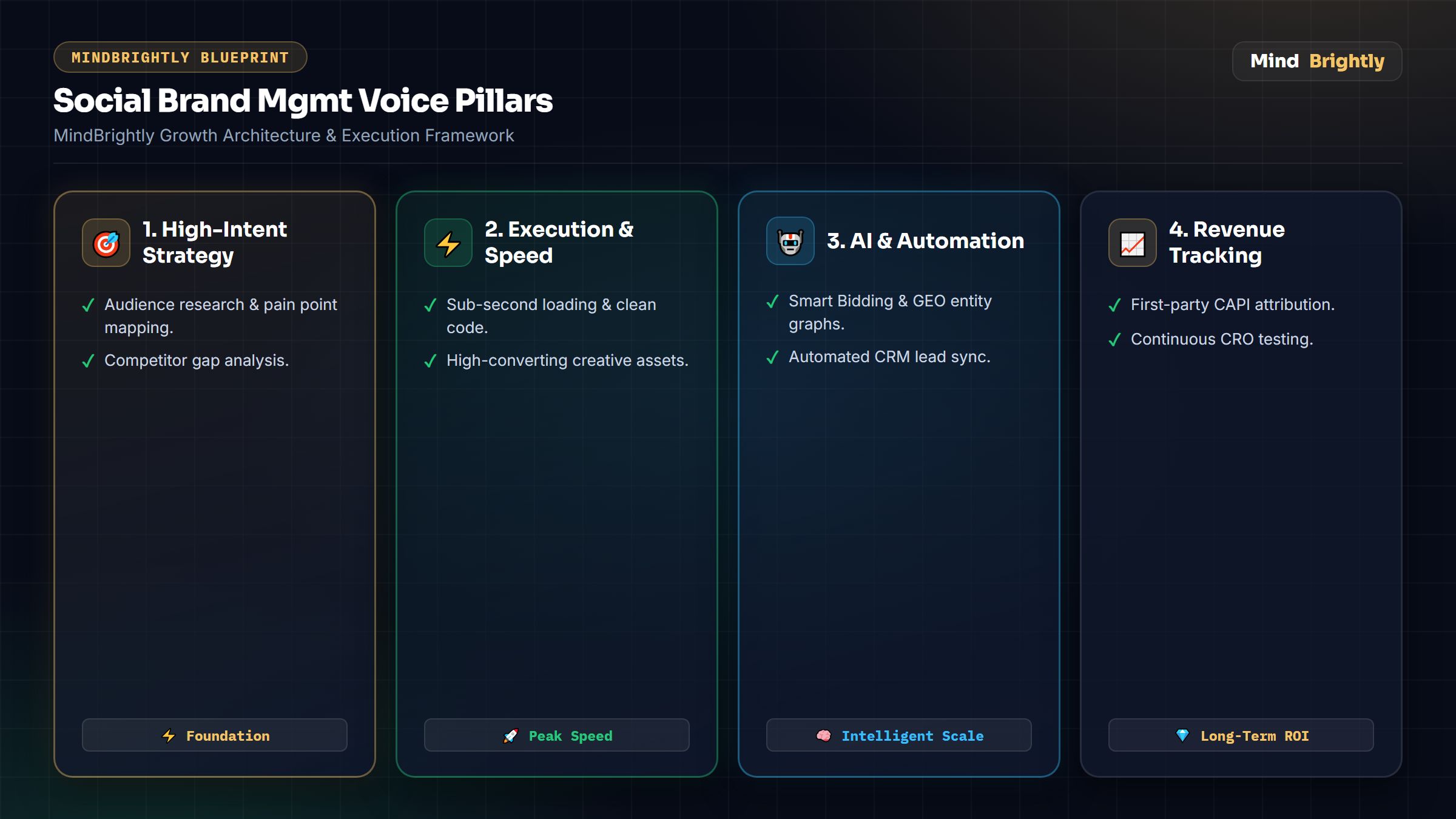
The Ultimate 2026 Framework for Dominating Content & Media
While the fundamentals of how often should you post on social media remain crucial, the landscape has shifted violently due to Generative AI, privacy protocols (iOS 14.5+), and changing consumer psychology. In this exclusive deep-dive, we break down the exact technical frameworks MindBrightly uses to generate 10x ROI for our enterprise and local clients.
1. The Shift to Generative Engine Optimization (GEO)
Traditional Search Engine Optimization (SEO) was built on "Ten Blue Links." In 2026, over 65% of informational queries end in a "Zero-Click Search." Users ask a question, and Google AI Overviews, ChatGPT Search, or Perplexity AI instantly provide the answer without the user ever clicking your website.
To adapt your Content & Media strategy, you must transition to Generative Engine Optimization (GEO). AI models do not read websites like humans; they parse knowledge graphs and assess entity relationships.
- Entity Salience: Your brand must be recognized as a distinct entity in Google's Knowledge Graph, not just a keyword string.
- Information Gain: AI models penalize derivative content. Your articles must include proprietary data, original research, or unique expert quotes that exist nowhere else on the internet.
- Citation Formatting: Structuring your data in clean, semantic HTML tables and bullet points increases the likelihood of an AI tool citing you as the primary source in a summarized answer.
2. Defeating Signal Loss with Meta Conversions API (CAPI)
If your Content & Media campaigns rely solely on browser-based tracking (like the standard Meta Pixel or Google Analytics 4 client-side tags), you are bleeding budget. Browsers like Safari (ITP) and Firefox aggressively block third-party cookies, and iOS 14.5+ users overwhelmingly opt out of tracking.
The Solution: Server-Side Tracking. By implementing Google Tag Manager Server-Side (sGTM), the data flow changes entirely. Instead of the user's browser sending a signal to Facebook (which gets blocked), your web server directly sends a secure, hashed API payload to Meta's servers.
This recovers up to 40% of "lost" conversion data. When Meta's Advantage+ algorithms receive 40% more conversion signals, they exit the learning phase faster, drastically reducing your Cost Per Acquisition (CPA).
3. The B2B Playbook: Account-Based Marketing (ABM)
Applying B2C tactics to a B2B Content & Media strategy is the number one reason agencies fail. B2B sales cycles take 3 to 12 months, involve multiple stakeholders (CFO, CTO, Procurement), and have high ticket values. You cannot sell a $50,000 SaaS contract using a generic Facebook image ad.
MindBrightly utilizes Account-Based Marketing (ABM). We do not target "demographics"; we target specific companies.
- IP Identification: We identify the corporate IP addresses of your top 100 target accounts (e.g., Infosys HQ in Bangalore).
- Role-Based Targeting: We run LinkedIn Thought Leadership Ads exclusively to employees holding "Director" or "C-Level" titles within those specific IPs.
- High-Intent Lead Magnets: The ad creative is never "Buy our software." It is an interactive ROI Calculator or an in-depth Industry Whitepaper that requires a work email to access.
4. WhatsApp Automation & Zero-Friction Lead Nurturing
In the Indian market, email marketing is practically dead for B2C and struggling in B2B. With average open rates plummeting below 15%, relying on email autoresponders for your Content & Media campaigns will result in massive lead drop-off.
Enter the WhatsApp Cloud API. With a 98% open rate, WhatsApp is the ultimate conversion engine. When a prospect submits a lead form on your website or Meta Ad, our automated systems instantly (within 3 seconds) send them a personalized WhatsApp message.
- Instant Gratification: The message contains exactly what they requested (a PDF brochure, a pricing link, or a portfolio).
- Interactive Buttons: We use WhatsApp interactive UI (Quick Reply Buttons) to ask qualifying questions like "What is your budget?" or "Schedule a Call."
- AI Chatbot Handoff: If the user asks a complex question, our integrated AI chatbot answers them instantly based on your company's knowledge base, only handing over to a human agent when the prospect is ready to close.
5. Conversion Rate Optimization (CRO) & Core Web Vitals
Driving 10,000 visitors to a slow, unoptimized landing page is a waste of capital. Your Content & Media strategy is only as strong as your Conversion Rate.
Google's Core Web Vitals (CWV) algorithm update mandates that sites pass stringent speed tests. Specifically, your Largest Contentful Paint (LCP) must occur under 2.5 seconds, and your Interaction to Next Paint (INP) must be under 200 milliseconds.
To achieve this, we abandon bloated WordPress templates. We engineer custom architectures using tools like Vite and static-site generation. A site that loads in 0.8 seconds not only ranks higher organically but enjoys a significantly lower Cost Per Click (CPC) on Google Ads due to higher Quality Scores.
Take Your Content & Media to the Enterprise Level
Stop losing market share to competitors with inferior products but superior data pipelines.
Explore MindBrightly's Core Services & Industry Solutions
Core Growth Services
Industry Specific Marketing
Flawless Execution
Our How Often Should You Actually Post on Social Media? Blueprint
We don't do guesswork. Every campaign follows a rigorous, data-driven framework designed to maximize ROI and eliminate wasted spend.
Deep Audit & Strategy
We analyze your current setup, spy on your top competitors, and identify exact conversion bottlenecks before spending a single rupee.
Technical Implementation
From Server-Side Tracking to robust Schema markup, we lay a flawless technical foundation so algorithms feed on perfect data.
Aggressive Scaling
Once we hit your target Cost Per Acquisition (CPA), we aggressively scale the budget using AI-bidding to dominate your market share.
FAQs About How Often Should You Actually Post on Social Media?
Common questions we get from founders and marketing heads.